 Arrenite
Letters · The Human Equation · Issue 05
The Price of Understanding
As AI grows smarter, what people will pay for extra intelligence is falling. On human limits, the gap between capability and competence, and what stays scarce.
On the same afternoon, two people ask the same free AI assistant the same question: why are there two high tides every day?
The first is a grandmother who spent her working life as a seamstress. Her grandson asked her on the beach, and she wants to answer him well. The assistant gives her a warm, clear explanation, with the Moon's pull on the water, and a picture she can describe with her hands. She is delighted.
The second is an astrophysicist, who asks it partly out of curiosity and partly as a test. She reads the same answer and notices that it smooths over a subtle point. It is not wrong, exactly. It is simplified in a way that is perfect for the grandmother and slightly unsatisfying for her.
Then the astrophysicist tries a more expensive model, and the difference is plain to her. Neither the grandmother nor the astrophysicist is mistaken. But only one of them could tell the difference, and only one of them would pay for it.
That small scene is worth holding onto, because something like it is playing out at a very large scale.
What the spending seems to show
We should be careful, so here is what we can say as of October 2026. A set of business spending data from Ramp, reported in September, suggests that the effective price American companies pay for AI output has fallen by about two-fifths from its peak in the spring, and that the share of that spending going to the most advanced models has slipped. Some of the biggest spenders have trimmed their budgets. Ramp's own economist called it a crack in the story, not a collapse, and other readers point out that total AI bills are still rising even as prices fall.
It is one data source, and it is early. We would not build a forecast on it. But it matches something many people sense: for a growing share of ordinary questions, the cheaper or free option is good enough, and the person asking cannot tell the difference.
We pay for what we can recognise
There is an old line in Proverbs that sounds as if it were written for this moment: "Wherefore is there a price in the hand of a fool to get wisdom, seeing he hath no heart to it?" (Proverbs 17:16, KJV).
Read slowly, it makes a modest point. Having the money to buy something is not the same as being able to use it. You pay for what you can recognise. If I cannot tell a better answer from a good one, I will not pay extra for it, and I will not be wrong to refuse.
This is a human limit, and a very ordinary one. Most of us are not able to judge the best work in most fields. We cannot tell a very good surgeon from an excellent one, or a fine legal argument from a brilliant one. When the intelligence on offer rises past what we can evaluate, the market for it narrows to the few people and organisations who can tell, and who have problems that are hard enough to need it.
Speaking as they are able to hear
If systems keep getting more capable, there is a second consequence. It has long been observed that when people differ greatly in ability and in the way they see the world, communication and trust get harder. The psychologist Leta Hollingworth noticed this about leaders in the 1930s, and put the gap at around thirty IQ points. A modern study of workplace leaders found followers began to see their leaders less favourably once the gap passed something nearer eighteen. The exact number is contested, and it measured perceived leadership, not conversation. But the idea has a plain core: a mind far from ours has to meet us where we are.
A system far beyond us, to work with us at all, will have to simplify. That is not a defect. The question is whether it can simplify without distorting, and whether it will simplify honestly or just tell us what we would like to hear.
The Gospels describe a teacher who did exactly this: "And with many such parables spake he the word unto them, as they were able to hear it" (Mark 4:33, KJV). We are not comparing a machine to God. We are noticing a pattern: the wise speak so that the listener can receive it, and they do not lie to do it.
Two lines on a graph
There is one more idea we think belongs here. It comes from people who work inside technology teams, and it is simple enough to draw.
Capability is what we can do, with whatever tools are at hand. Competence is what we understand and can judge for ourselves: the skill to do the thing, and to tell whether it has been done well.
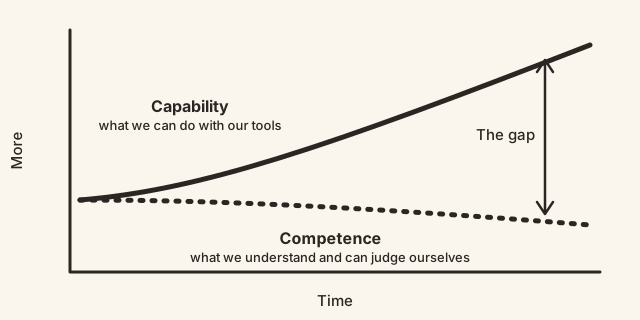
For most of history the two rose together, because to do something you had to learn it. Now they can come apart. A person can produce a report, a program, a plan or a translation without understanding how it was made, and sometimes without being able to tell whether it is any good.
Early research hints that this is more than a feeling. Studies of how people use AI at work and at school suggest that the more we hand over, and the more we trust the answer, the less we think for ourselves, and that this effect is clearest in people who start with the machine's answer instead of their own attempt. The evidence is early and mostly shows links, not proof of cause, and how we use the tools seems to matter more than whether we use them. But it is a warning worth taking seriously.
The risk is not that the machines are not capable enough. It is that the gap between what we can do and what we understand keeps widening. In that gap, we cannot tell a better answer from a worse one, and so we cannot tell what is worth paying for, or what is safe to trust.
What this means for the people who built it
There is a question that follows, and we want to hold it without pretending to answer it. Many of the companies building the most advanced AI have borrowed heavily to do it, and they need many people and organisations to keep paying for something that, to most users, looks increasingly like something free.
Perhaps the people with hard problems, who can tell the difference, will pay enough. Perhaps the money will move toward reliability, trust and the ability to fit into real work. Perhaps it will not be enough. History shows both endings: after earlier building booms, the railways and cables outlasted many of their builders. We are not market analysts, and this letter is reflection, not financial advice. The point we would draw is human, not financial: you cannot sell understanding to someone who cannot recognise it.
What stays scarce
When intelligence becomes abundant, the scarce thing is not more of it. It is the wish to understand.
When the young King Solomon was offered whatever he asked of God, he did not ask for riches or for more cleverness. He asked: "Give therefore thy servant an understanding heart to judge thy people, that I may discern between good and bad" (1 Kings 3:9, KJV). He asked for the ability to recognise what is true and good, and to use what he had been given well.
"Wisdom is the principal thing; therefore get wisdom: and with all thy getting get understanding" (Proverbs 4:7, KJV). We can now get an astonishing amount for very little. The question has become whether we will also get understanding, and whether we will want to.
The Human Equation looks at artificial intelligence, technological progress, economics and human meaning, and tries to separate what we can observe, what we can reasonably expect and what remains ours to decide. This letter is reflection, not financial advice.
Sources and further reading
- Ramp business spending data, reported by Fortune (September 2026); effective AI prices and the share of spending on the most advanced models. One data source, early.
- Hollingworth, L. S., on leadership and intelligence (1930s); Antonakis, J., House, R. J., and Simonton, D. K., "Can super smart leaders suffer from too much of a good thing?", Journal of Applied Psychology (2017). The size of the gap is contested.
- Lee, H.-P., et al., "The Impact of Generative AI on Critical Thinking" (Microsoft Research and Carnegie Mellon University, 2025); Gerlich, M., "AI Tools in Society: Impacts on Cognitive Offloading and the Future of Critical Thinking", Societies (2025). Early studies; mostly correlational.
- Proverbs 17:16, Mark 4:33, 1 Kings 3:9 and Proverbs 4:7, King James Version.
Statistics and studies are described as of the date of this letter. Please check the originals for current figures.
Terms in this letter
- capability
- What a person or organisation is able to do, with whatever tools are at hand.
- competence
- The skill and understanding to do something well yourself, and to judge whether it has been done well by anyone, including a machine. Learn more