 Arrenite
Letters · The Human Equation · Issue 01
Beyond the Job Title
What do you do? As machines take on more of our work, what is a person for? On purpose beyond the job title, and why our worth was never our output.
Technology follows patterns. Human meaning asks a different question.
There is a question Americans ask almost automatically when meeting someone new:
"What do you do?"
We usually mean, what do you do for a living? An engineer. A teacher. A truck driver. A nurse. A lawyer. A business owner.
Those answers tell us a surprising amount about how we see ourselves. They suggest our education, our income, our responsibilities, our place in society, and sometimes even our worth. For generations we have organized adult life around work: we prepare for a career in our youth, build one in our middle years, and often describe retirement as what is left when the career ends.
So what happens when machines can help with more and more of our thinking work? When they can do not only physical tasks but the thinking work we once assumed belonged to people?
That is not only a question about jobs. It is a question about identity, and about what a human life is for. This first issue is about that question. The economics, including who shares the gains, we will leave for the next one.
Three words that get confused
Before anything else, it helps to be careful about what we claim. Technology is not magic. It follows patterns: physical limits, accumulated knowledge, human decisions and economic incentives. Philosophers call the idea that events follow from earlier conditions and the laws of nature determinism.
But three ideas are often mixed together, and the difference matters.
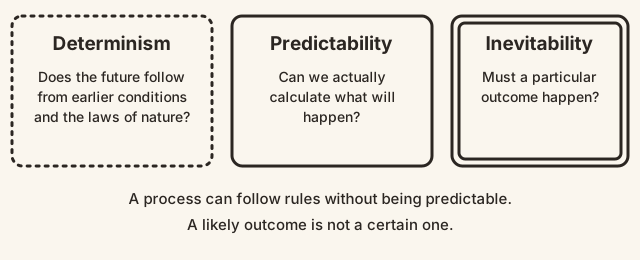
We can see strong directional forces at work without pretending to know when, how fast or how it ends. That is the posture we want to keep through this series: say what we can observe, say what we can reasonably expect, and be honest about the rest.
Why the question is arriving now
For most of history, useful intelligence came attached to a person. A skilled accountant needed years of training. A physician gathered knowledge over a career. Expertise was scarce because it took human time to build.
AI changes that relationship. Once a capable system exists, some of what it can do can be offered to very many people at a far lower extra cost than training one more specialist. Computing, electricity and oversight are never free, but the economics shift. If a machine can do a task reliably, at a lower total cost, organizations have a reason to use it. First as a tool, then for whole stretches of work. That is automation.
It helps to separate a task from a job. A job is many tasks plus responsibility, relationships, judgment and accountability. Automating some tasks does not automatically remove the job. It can change it, or make the worker more productive.
The evidence so far is mixed, and we would rather show that than pick a side. An International Monetary Fund staff discussion note in January 2024 estimated that about six in ten jobs in advanced economies are exposed to AI, with roughly half of those likely to benefit from higher productivity and the other half at risk of reduced demand for workers. Exposed means AI can affect some tasks, not that the job disappears. A more recent study from Stanford's Digital Economy Lab, using pay records for millions of US workers and revised in August 2026, found no sign of widespread job loss across the economy. It did find that employment of workers aged 22 to 25 in the jobs where AI can do the most tasks was 19 percent below where it would have been had it kept pace with less-exposed peers, mostly because fewer young people were being hired. The authors stress these are early signs, not proof that AI caused them.
Broad exposure, early signs of disruption and real uncertainty about what follows: that is the honest picture.
Our own expectation, as a judgment and not a certainty, is that machine intelligence will keep getting more capable and cheaper, and that a large share of knowledge work will be done differently within the working lives of many readers. Physical work will follow more slowly and unevenly. We also think the same technology could put a patient tutor in front of a child who could never have afforded one, even as it narrows the advantage of some specialists. Who benefits is not decided by the technology. It depends on institutions and choices, which is the subject of the next issue.
One thing needs saying plainly now. Nothing in this letter is a reason to tell someone who is struggling to pay rent that purpose is a substitute for security. Material well-being matters. Stable communities matter. Having choices matters.
But there is a second problem that no economic model can solve, and it is the one we want to spend the rest of this letter on.
What would you do tomorrow morning?
Imagine a world in which most of what we need for a comfortable life can be produced with little human labor, and in which society has found a way to give people material security. What would you do tomorrow morning?
For some people the answer comes quickly. They would spend more time with their children, build a garden, learn an instrument, care for aging parents, study the natural world. Others might feel unexpectedly lost.
Work gives us things money does not. It gives structure to our days, colleagues, challenges to overcome, evidence that we are useful, and recognition from others. Losing a profession can be a real loss of identity even when the bills are paid. We should not wave that away, or pretend anyone can swap a career for a hobby overnight.
But perhaps we have confused two different ideas. Being useful is not the same as being valuable.
Being economically useful is not the same as being valuable.
A parent comforting a frightened child is doing something meaningful, though nobody pays them. A neighbor who helps someone recover from an illness adds to human well-being without sending an invoice. We already know this in much of life. We do not ask a child to justify their existence by their output. We do not believe an elderly person loses their worth at retirement. We do not measure a friendship by what it earns.
Somewhere between childhood and adulthood, though, many of us start treating paid work as the central measure of a successful life. This assumption deserves to be examined.
Meaning is not a competition with machines
Suppose a machine becomes a better chess player, composer or mathematician than almost any person. Does that make chess, music or mathematics meaningless to us? Of course not. People run marathons knowing they will never be the fastest. They cook although restaurants employ better chefs. They sing with ordinary voices. They learn, build, explore and create because the experience itself matters.
We find meaning less in being the best than in taking part, growing, connecting, being curious and finishing something. In a world of very capable machines, that distinction may become essential. We may need to separate purpose from competitive advantage.
The research agrees. In a 2021 survey of 17 advanced economies, the Pew Research Center asked people, in their own words, what makes life meaningful. Family was the most common answer in 14 of the 17. Work and material well-being mattered too, but they were never the whole picture. Americans stood out for something else: they were more likely than people in the other countries to mention faith.
Where we stand
Arrenite is a Christian project, so we will say where this leads us, while recognizing that readers come from many places.
The Christian tradition has an old answer to "what is a person worth?" It says that people are made in the image of God: "So God created man in his own image, in the image of God created he him" (Genesis 1:27, KJV). On that view, worth is given before anyone achieves anything. It is not earned by being useful and it cannot be lost by becoming less useful. The psalmist asks the same question we are asking, "What is man, that thou art mindful of him?" (Psalm 8:4, KJV), and the answer he reaches is wonder, not a job description.
The tradition has a wider word for what we do with our lives, too: vocation, or calling. A calling is bigger than a paycheck. A parent, a neighbor, a teacher, a builder and a friend can all be living one out. And it has a rhythm to protect that truth, the Sabbath: a regular day set apart from striving, which says week after week that you are more than what you produce.
You do not have to share our faith to feel the force of the claim. But we think it is where the deepest answer lies: our value was never confined to what we could produce.
The human equation
The future of AI is often described as a race. Which company builds the strongest system? Which country leads? Which profession survives? Which people adapt fast enough? Those questions matter, but they are not the whole story.
Human civilization may be approaching a period in which useful intelligence, and eventually much physical labor, depends less and less on human effort. That could widen inequality or narrow it, concentrate power or spread opportunity, bring deep insecurity or make a materially richer life available to more people. None of that is settled.
What may be settled, if we choose it, is the question underneath: what is a good human life, and how do we make it possible for more people to live one?
The machines may become extraordinary at solving problems. We will still have to decide which problems are worth solving. And if intelligence and labor stop being the measure of our contribution, we may finally have reason to explore something that was always true.
Our value was never confined to what we could produce.
The Human Equation looks at artificial intelligence, technological progress, economics and human meaning, and tries to separate what we can observe, what we can reasonably expect and what remains ours to decide.
Next issue: When work changes, who shares the gains?
Sources and further reading
- Stanford Encyclopedia of Philosophy, "Causal Determinism".
- International Monetary Fund, Staff Discussion Note SDN/2024/001, "Gen-AI: Artificial Intelligence and the Future of Work" (January 2024).
- Stanford Digital Economy Lab, "Canaries in the Coal Mine? Six Facts about the Recent Employment Effects of Artificial Intelligence" (revised August 2026).
- Pew Research Center, "What Makes Life Meaningful? Views From 17 Advanced Economies" (November 2021).
- Genesis 1:27 and Psalm 8:4, King James Version.
Statistics and studies are described as of the date of this letter. Please check the originals for current figures.
Terms in this letter
- artificial intelligence
- Computer systems that do tasks which usually need human thinking, such as recognising speech, sorting images or writing text. Often shortened to AI. Learn more
- determinism
- The idea that events follow from earlier conditions and the laws of nature. Whether the universe is fully deterministic is still an open question. Learn more
- automation
- Using machines or software to do a task with little human effort each time it is repeated.
- knowledge work
- Work done mainly with information, like writing, analysis or planning, rather than with physical tools or materials.
- made in the image of God
- The Christian teaching, from Genesis 1, that every person bears God's likeness, so each life has a worth that is given, not earned or produced. Learn more
- vocation
- A calling: the particular ways a person is invited to serve God and other people, in work, family, church and community. Traditions describe it differently. Learn more
- Sabbath
- A regular day of rest and worship. It is rooted in Genesis 2 and the Ten Commandments, and Christians keep it in different ways and on different days. Learn more