 Arrenite
Made for more than output
Tools now write, draw and answer in seconds. What is left for a person to do? A gentle look at purpose, meaning and the difference between a task and a calling.
Most of us have had the quiet moment. You watch an AI tool draft in seconds what you would have laboured over for an hour, and a small question rises: if this can be done so fast, what is left for me?
We want to start these letters by taking that question seriously, without panic and without pretending it is not there.
Tasks are not the whole of a life
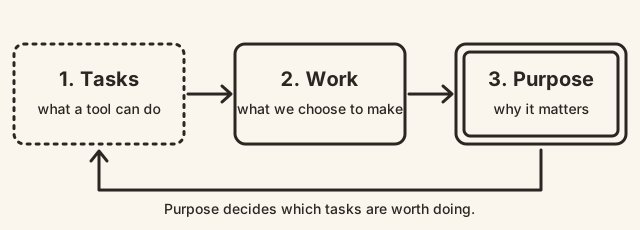
A task is a thing that can be finished and ticked off: summarise this page, sort these photographs, draft this email. Tools are good at tasks, and they are getting better. That is worth being glad about when it frees time for what matters to us.
But a life is not a list of tasks. It is made of relationships, promises, places, and the slow work of becoming a particular person. None of that finishes. None of it can be handed off without losing the point of it.
Fluent is not the same as wise
A large language model is very good at producing language that sounds right. That is a real skill, and also a trap. Sometimes the answer is simply wrong, and it can be wrong in a smooth, confident voice. People call this hallucination.
Speed is easy to get. Wisdom still takes time.
This is where an old word becomes useful again: discernment. It means slowing down enough to ask three plain questions. Is this true? Is this good? Is this mine to do? Those questions were never about technology, and they are not made obsolete by it.
A calling is bigger than a job
Many Christians use the word vocation for the idea that a person is called, and that the calling is wider than a paycheque. A parent, a neighbour, a teacher, a builder and a friend can all be living out a calling. In this view, purpose is something received and offered, not something earned by output.
The psalmist asked the question that sits under all of this: "What is man, that thou art mindful of him?" (Psalm 8:4, KJV). The answer the Bible gives is not "because of what he produces." It is that we are known and cared for first.
A rhythm that protects the rest
If purpose is bigger than output, we need rhythms that remind us. The oldest one is the Sabbath: a regular day set apart from striving. Traditions keep it differently, and you may keep it quietly in your own way. What matters is that it says, week after week, that you are more than what you get done.
Where we go from here
These letters will come as we write them, not on a timetable. We will use AI tools to help us write, and we will say so on every letter. We will try to ask honest questions, offer small practices and point to older wisdom. If something here is wrong, or unhelpful, tell us at [email protected] and we will correct it.
Thank you for reading.
The Arrenite team
Terms in this letter
- artificial intelligence
- Computer systems that do tasks which usually need human thinking, such as recognising speech, sorting images or writing text. Often shortened to AI. Learn more
- large language model
- An AI system trained on huge amounts of text to predict and produce language. It can sound confident and fluent without understanding the way a person does. Learn more
- hallucination
- When an AI states something false in a smooth, confident way, such as inventing a quotation or a source that does not exist. Learn more
- discernment
- The patient practice of telling what is wise, true and good from what is only appealing, often with prayer, Scripture and trusted counsel. Learn more
- vocation
- A calling: the particular ways a person is invited to serve God and other people, in work, family, church and community. Traditions describe it differently. Learn more
- Sabbath
- A regular day of rest and worship. It is rooted in Genesis 2 and the Ten Commandments, and Christians keep it in different ways and on different days. Learn more